
The Archangel’s Gift: The Point of No Return
Lorenzo has two days to get to Rome if he wants to see his son again. Trouble is, his ship is going the wrong direction...

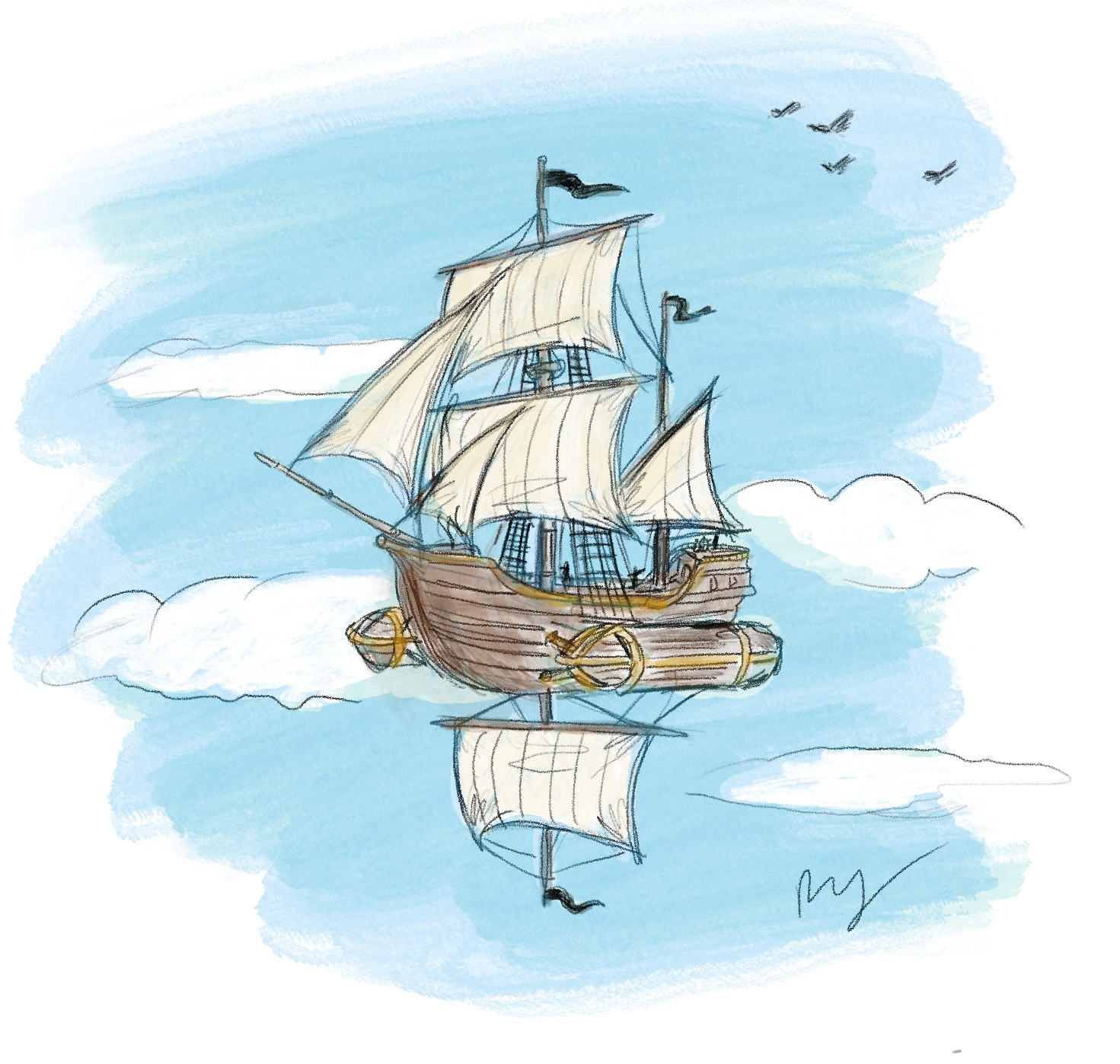
Author’s note: This chapter relies on some real nautical know-how, as well as a good deal of completely made-up nautical know-how. To some degree, I’m still figuring out the finer points of skyship lore, but I think I've more or less got the sails and rigging right, as well as the mechanics of lift gas. Still, don’t be surprised if you come back to this chapter and see some slight differences as I continue to refine my conception of how skyships fly.
If you enjoy this chapter or the accompanying illustration, give it a like or comment!
EVERYTHING YOU NEED TO START READING: Many years ago, twelve Archangels saved Renaissance Italy from a global flood. They lifted each of the major city-states into the air, creating floating islands.
Lorenzo de Montague, a notorious thief recently released from the hellish underwater prison known as the Sinkhole, has spent the last week searching for his family on the island of Porto Nero. After a drunken brawl in a taverna, he is rescued by an old associate named Marcello, who has news: Lorenzo’s young son Giuliano is alive, but he’s being held hostage by the crime lord known as the Spider. If Lorenzo ever wants to see him again, he must carry out a job for the Spider on the island of Rome, and he has two days to do it. But just as Lorenzo and Marcello part ways, a band of constables catches up with him and arrests him for his part in the earlier brawl, clubbing him unconscious…
When Lorenzo came to, his head was throbbing so bad that he almost missed the creak of rope and the flapping of sails.
He opened his eyes. No, ouch—just one of them. The other was fixed shut, most likely thanks to the forceful ministrations of that idiot Carlo and his brothers—though, given the condition he’d left them in, this was most certainly a “you should have seen the other fellow” sort of situation. Lorenzo looked around and groaned, feeling a stab of panic.
No. I can’t be here.
He knew the acrid smell of pitch blended with the vanilla scent of windwood. He knew the familiar arrangement of bars on the bulkhead. And he was intimately familiar with the shackles binding his wrists to the seat.
He was back on the damned prison ship.
“Doom and Deep!” he swore. “I can’t be here. Let me out!”
The brig of the prison ship was tiny, big enough for four or five people if those people neither cherished personal space nor minded getting on very good terms with each other. At the moment, Lorenzo was the space’s only occupant. That changed a moment later when the door opened with a creak of rusting iron hinges, and a figure darkened the threshold.
Lorenzo knew the newcomer from the voyage out of the Sinkhole, a ratty little man wearing Penal Corps black. Horatio was one of several prison guards whose job it was to ferry inmates to and from the Sinkhole. He wore an unpleasant expression on his narrow face.
“Gotta be honest,” said Horatio, his weapon half-raised. Lorenzo couldn’t help but notice he was carrying the shiny Drago pistol he’d had taken off Marcello. “I hoped we were rid of you.”
“Trust me, the feeling’s mutual,” Lorenzo said, tugging at his manacles. “How’d I end up here? Constables dump me on you as a farewell present?”
“The jail on Porto Nero’s already full, what with the refugees and all. Lots of brawls since Palermo fell, I guess. So they caught us as we were casting off and threw you back at us.”
Lorenzo’s jaw clenched. “And we’re headed back to Venice, is that it?”
“Aye. Shouldn’t require any more stops, either. We’re loaded up on leviathan’s breath and provisions.” Horatio gave Lorenzo an appraising look. “If you’re quiet and keep your head down, I won’t tell anyone you broke parole.”
“Broke—” Lorenzo stopped cold. “What do you mean, broke parole?”
“The men you brawled with in the taverna, de Montague. They’re in bad shape. If the Venetian Commonwealth finds out you committed violence, that parole’s revoked. You’ll be a condemned man again.”
Lorenzo cursed.
“But as long as there’s no trouble here, nobody has to find out.” Horatio removed a pair of keys from his pocket. “We in agreement there?”
Lorenzo nodded. “Much obliged.”
Horatio seemed to relax. He stuffed the Drago pistol into his belt and took a step toward Lorenzo, keys in hand. “I’m from the same place as you. I lost people too. It’s a big, damned awful world, but we’re in it together.”
Lorenzo felt oddly touched. Seemed the barrier between guard and prisoner had fallen with Palermo. He hated himself for the opportunity he saw in those words.
“That so? Look, I could use another favor.”
“What’s that?” Horatio bent down to unlock the manacles around his wrist. “Other than—like I just said—not tellin’ anyone about your little tussle back there?”
“Take me to Rome.”
“Why the Deep would we want to go to Rome?” asked Horatio, pausing in the act of freeing him. “You gettin’ devout on us, de Montague? You want to join the Divinocracy?”
“Sure,” Lorenzo said. “Always thought I’d look fetching in a cassock. All that shapeless cloth would really accentuate my assets, you know?”
Horatio snorted and resumed working the key into the lock, and the manacles fell away. “Why the bloody Deep do you want to go there? We’ll drop you off at Venice and get new orders.”
“I ain’t going to Venice,” Lorenzo said calmly. “This time of year, it’s the wrong direction.”
“Why do you need to go to Rome so badly?” asked Horatio.
Lorenzo debated. As duly appointed officers of His Grace the Duke, the prison guards weren’t all that likely to send him off to Rome with a smile and a spare set of sails if he told them he’d been recruited by Venice’s biggest crime lord. But half the truth? Lorenzo could manage that. “Just found out my son’s alive. But he’s being held hostage. If I don’t get to Rome soon, there’s no telling what’ll happen to him.”
“Your son’s on Rome?” Horatio asked, concern in his eyes. The guard was a good sort, Lorenzo determined. For a fellow who shuttled people to and from a hellish underwater mine for a living.
Lorenzo nodded, brushing away the lie. “I’ve got to get to him before some very bad people decide he’s not worth keeping alive.”
Horatio’s mouth thinned. “De Montague, I can’t—I can’t just change course. I have my orders. I’ve got a duty. Me and the other guards.”
“I get that,” Lorenzo said, trying and failing to keep the impatience out of his voice. “But I’ve got to get to Rome. I’ve only got two days.”
“I’m telling you, de Montague, we can’t do that,” said Horatio. “I’m sorry.”
“Then drop me back at Porto Nero, constables be damned.” Lorenzo paused, working through the cartography in his head. The deadline was tight, but if he stole a fast enough ship, he could make it work. “Let me make my own way to Rome. I can be on a ship by this evening and—”
“De Montague,” said Horatio, tensing. “There’s no way you could get back to Porto Nero in a few hours. What day do you think it is?”
“What?” Ice crawled through Lorenzo’s veins. “What day? It’s … the seventeeth, isn’t it? A Thursday?”
Horatio shook his head. “The constables hit you hard, and you must have had a concussion from your run-in with those thugs. We had you lying down on a mat, feeding you through a straw. As soon as you started to stir, we chained you here in case you got violent.”
The ice in his veins froze into a fist that seized Lorenzo’s innards and twisted. “What are you sayin’? How long have I been out?”
Horatio hesitated.
“How—long?” Lorenzo hissed.
“A full day. It’s Friday afternoon.”
Lorenzo shot to his feet. Anger rose in his gut: anger at himself for letting this happen, anger at Horatio for his reticence, and anger at the bloody Spider for putting him in this wretched position. By the time he got back to bloody Porto Nero, hired a ship, and sailed to Rome, he’d be a day late at the earliest. Maybe even two. “A day—I ain’t got time for that.”
“I’m sorry, de Montague,” said Horatio, and he sounded genuinely sorrowful. “We can’t go to Rome. That’s—I’d have to check the arcolary sphere, but I’d guess at least sixty leagues from here. Sixty leagues in the wrong direction. If we took a detour like that—best case, the other guards and me’d be drummed out of the Penal Corps. Worst case, we’ll get the execution drop for stealing one of His Grace’s skyships.” Horatio hung his head, unable to look Lorenzo in the eye. “And I’ve got a family, too. I can’t, I’m sorry.”
Coward. His fury threatening to boil over, Lorenzo revised his earlier assessment of Horatio, but he kept the epithet from escaping his lips.
“We couldn’t even make it if we tried,” insisted Horatio. “Even with a fair wind, we’d be hard-pressed to get there in time.”
That’s because you’ve never sailed with the Viper of Venice, Lorenzo thought. If there was one thing the stories got right, it was that Lorenze de Montague was a damned fine aeronaut.
They just had to give him the chance.
A terrible idea burrowed itself into Lorenzo’s thoughts. Somewhere in the back of his mind, he started charting a course into forbidden skies. He eyed the pistol now hanging near Horatio’s hip, making a show of composing his features into something approximating calm. “Fine.”
“Fine?” Horatio repeated, looking hopeful. “De Montague—”
“I said fine,” Lorenzo snarled, putting just enough venom behind the words to imbue them with conviction. It wasn’t hard. “You’re right. Bloody Doom and Deep, but you’re right.” He let out a loud, heavy sigh freighted with grief and pain that wasn’t at all feigned. “We’d never bloody make it in time.”
“I’m so sorry,” said Horatio.
“Not your fault,” said Lorenzo, holding up a hand. “Blame the archangel of the bloody winds.”
“We’ll hurry back to Venice and see if we can get the word out to the constables in Rome,” said Horatio in a consoling tone.
“You promise?” Lorenzo asked, letting a hopeful expression settle onto his face.
“Yeah,” said Horatio. “It’s the least we can do. Your son’ll be all right, de Montague.”
“Well,” said Lorenzo. “On that count, I think we can agree.” He extended a hand.
Horatio gave him a curious look, but he reached out to clasp Lorenzo’s outstretched hand.
The moment he had Horatio in his grip, Lorenzo spun, pulling the other man to the deck. The guard let out a cry. Lorenzo tore the Drago from the man’s hand in the same motion, flipping it around to point at Horatio’s temple.
The guard, now on his back, looked up with shock and betrayal in his watery eyes. “De Montague—what are you—”
“Shut up and don’t move,” said Lorenzo, “and you won’t find yourself with the urgent regret that you never learned to fly.”
Horatio blinked. “What?”
“You won’t find yourself with the—” Lorenzo shook his head. Sometimes his wit was lost on people. “Never mind. Means I won’t throw you overboard.”
“I thought we decided—”
“You decided, Horatio,” said Lorenzo, reaching down to remove the keys from the guard’s belt. “Now, you’re going to stay in here, nice and quiet, or we’ll revisit that whole ‘throwing overboard’ thing. Got it?”
Horatio nodded, but his eyes darted past the open door to the brig. Lorenzo knew what he had to be thinking—surely one of the other guards had heard Horatio’s yelp when Lorenzo first threw him to the ground, or the thud of the impact.
“Tell you what,” said Horatio, his voice high and pleading. “You hand me those keys and the pistol, and we’ll forget about your scuffle on Porto Nero and whatever’s happening here. We’ll even have a drink on Venice and laugh about it.”
Lorenzo ignored him, poking a head out of the brig door and peering up the companionway. The other two guards stood on the quarterdeck, but neither of them seemed to take any notice so far. Good.
“If you do this,” sniffed Horatio—angels above, was he crying already?— “If you do this, you can kiss your parole goodbye. You won’t be able to set foot on a civilized island ever again. You’ll be a wanted man, de Montague.”
“Well, better than being unwanted,” said Lorenzo, stepping out of the brig. He shut the door, locking it. “Remember what I said about staying quiet.” Then he marched up the companionway, Drago in hand.
He climbed toward the main deck. He’d thought he had missed the gentle rocking sensation as the skyship rode the thermals through the air, but years in the Sinkhole had stripped him of his air legs, and he felt queasy. Or maybe that had more to do with what he was about to do.
The prison ship wasn’t a large vessel. In fact, it was pretty damned tiny. It would have been a lighter but for the fact that it was as fat and slow as a bull leviathan. It took Lorenzo only a moment to climb on deck.
The quarterdeck jutted from the rear of the ship like a balcony over the clouds, its brass railings glinting in the sun. Just past the railing stretched the pylons that held leviathan’s breath: two long, slim wooden tanks banded by bronze, one on either side of the ship, inside which lay the miraculous buoyant gas that kept the ship flying.
Overhead, wind snapped through the rigging and fluttered the sails. The Abyss, the boundless ocean that covered the surface of the world, lay fifteen thousand feet below, while clouds drifted lazily past the ship’s rail. The blue bowl of the sky kissed the gray plane of the sea from horizon to horizon, and the sun was a benevolent presence overhead, the breeze crisp and cool.
All in all, it was a lovely day for a mutiny.
Ascalo, another guard in the black doublet of the Venetian Black Armada’s Penal Corps, leaned against the rail. He gave Lorenzo a puzzled look when he caught sight of Lorenzo’s determined expression. One hand went to his own pistol hanging at his belt.
Lorenzo didn’t pause. The quarterdeck was dominated by the pilot’s station: a brass-knobbed ship’s wheel surrounded by a rack of navigational equipment, like a mounted compass and a small bronze globe circled by dozens of tiny rings. A stocky man, also in Penal Corps black, labored at the wheel. Lorenzo noted the pistol hanging from a bandolier at his chest. If Lorenzo remembered correctly, the pilot’s name was Dario.
The way Dario held the ship’s wheel, his hands too high on the knobs and his back too rigid, betrayed a lack of familiarity with skyships. That was just typical of the Penal Corps, who weren’t exactly the cream of the Venetian Black Armada, tossing inexperienced guards on a ship with cursory training and expecting them to sail the skies. After all, what did the Venetian Commonwealth really lose if one prison ship went down?
Lorenzo hid a dark little grin. All the better.
The pilot spotted the weapon in Lorenzo’s hand and acted more quickly than Ascalo did. He raised his own wheellock and pulled back the hammer, keeping his other hand on the ship’s wheel. “Nobody but guards are allowed to carry weapons,” he said coolly. “You know that, de Montague.”
Against the rail, Ascalo raised a pistol too. Two against one now.
“Always thought that was a silly rule,” said Lorenzo breezily. “Without a weapon, how am I supposed to strut about, waving a gun to advertise how tough I am, paradoxically using the weapon to compensate for my anatomical failings and innate lack of self-assurance?”
The guards stared blankly.
“What?” asked the pilot, Dario.
Lorenzo sighed. Again, what was the use of wit these days? “Means … ‘no, thanks.’ ”
“Give me the weapon,” snapped Dario.
“I need you to change course,” said Lorenzo, letting the levity drain from his voice. “We’re going to Rome.”
“Rome?” Dario scoffed. “Our orders are to return to Venice, and that’s what we’re doing.”
“Thought you’d say that,” said Lorenzo. “Let the record show I gave you a chance.” The Drago made a satisfying clicking sound as he pulled the hammer back.
“From the looks of it, de Montague,” chimed in Ascalo, off to the side, “that pistol in your hand’s got two shots. You might get one of us, but both? Good luck.”
Personally, Lorenzo thought he might very well be fast enough to take them both out before they got a shot off. That was another thing the stories got right. Putting a lead ball into both guards would be the fastest route to get where he needed to go. But Giuliano’s voice intruded in his mind again, reminding him of the things he’d resolved to become back in the taverna on Porto Nero.
Bloody hell, I’ve got to do this the hard way, don’t I?
“Yeah, you’re right on that count,” said Lorenzo.
Dario’s expression relaxed half a degree. “What, then? What’s your plan, de Montague? How long are you going to point that thing at me?”
“I’d say about another five seconds, give or take,” said Lorenzo.
Dario blinked. The pistol wavered in his hand.
“What? Why?” Ascalo demanded.
“Because,” said Lorenzo, “that’s when I’m going to do this.”
He turned and fired once at the starboard leviathan’s breath cask.
The screams of the guards seemed just as loud as the Drago’s report as a hole appeared in the side of the cask, the air seeming to shimmer and sway as the gas fled into the air. Lorenzo’s stomach lurched as the deck started to careen, the entire ship listing to starboard.
The casks were aged in a special solution distilled from leviathan blubber for weeks to harden the wood, keeping them resistant to impact. But a good aeronaut knew the casks weren’t indestructible—you could see striations in the wood, marking places where the solution didn’t quite sink in. Places where a lead ball would still penetrate.
“What the hell are you doing?” Dario roared, grabbing for the rigging with his free hand.
“Equalizing,” said Lorenzo, as he turned and shot the tank on the other side.
Dario’s eyes bulged. Ascalo screamed.
“Any minute now, we’re gonna start sinking,” said Lorenzo with carefully manufactured calm, even as bells of fear went off in his head. “Now I’m gonna wager the Penal Corps didn’t exactly give you fellows the finest training. You practiced fixing a broken breath cask back in port, but can you do it with the whole ship falling around you?”
Dario glanced at Ascalo. They said nothing, but their shared look of terror confirmed Lorenzo’s suspicions. Worthless in the air when it came down to it, both of them.
Good.
“I can fix the casks,” he said. “But if I’m going to do it, I’m gonna need you to do something for me.”
“You’re mad,” snarled Ascalo.
“No, just disappointed.” The ship was still too high in the air to tell a difference with his eyes, but the lurch in his stomach made it absolutely clear that they were already losing altitude.
Dario had gone white. “I suppose you’re going to ask us to take you to Rome, huh?”
“Not all,” said Lorenzo. “I need you to give me your keys and get in the brig with our mutual friend Horatio.”
“And if we refuse?” Ascalo demanded.
Lorenzo shrugged. He flicked his head toward the portside cask, which was audibly hissing now. His heart throbbed with anxiety in his chest, faster with every passing moment, but he fought to keep his voice calm and level as the sea beneath them.
The sea that grew closer with every passing second.
“I guess we’ll see how well we can all swim, won’t we?” Lorenzo asked.
“You won’t.” Ascalo looked at Dario. “He wouldn’t. He’s bluffing.” But it was a question rather than the statement of assurance he surely meant it to be.
“Maybe, maybe not,” said Lorenzo. If his heart beat any faster, it might break free of his ribcage. But still he fought to stay calm, collected.
Over the rail, he could almost make out waves on the flat gray expanse of the Abyss. Maybe seven or eight thousand feet away now. He grabbed a rail as the deck swayed, the ship slowly spiraling now as the two casks vented gas at different rates, like a leaf lazily drifting toward the earth. At some point, the ship would pass the point of no return—when no amount of scrappy repairs could bring it back to the skies. How much longer did they have?
The guards might not know much about skyships, but you didn’t have to be a bloody aeronautical engineer to know that having your ship fall from the sky wasn’t the sort of problem you dealt with after tea and a good chit-chat.
“You promise you can fix it?” Ascalo asked Lorenzo desperately, his voice high and panicked now. With the speed of the ship’s fall starting to go from lazy to unmistakably a cause for alarm, the guard clutched the rail like it was his dear mother’s hand.
“On my son’s life,” said Lorenzo, serious as the plague.
Ascalo glanced at the casks again, then turned without another word and hurried down the companionway. Dario stared, open-mouthed. Cursing, Dario hurried after Ascalo. There was a shout from Horatio as Ascalo unlocked the brig and flung himself inside, followed a moment later by a grumbling Dario.
“Lock yourselves in and toss me the keys!” Lorenzo called down, moving to stand on the edge of the companionway that led down to the brig.
There came a clang as the brig door shut, then a clatter of metal. Lorenzo picked up the keys where the guards had tossed them—two sets—and hung them on a nail on the mast, just beneath a weathered, painted icon of the Archangel Genoviel, patron of aeronauts.
“Keep an eye on these, will you?” Lorenzo told the angel. “Oh—and if you’ve got a minute to spare, see if you can help me keep this bloody ship flying.”
With that, he darted to the portside rail, grabbing a rope that hung from the mast. He unwound it and wrapped it around his midsection, securing it with a tried-and-true aeronaut’s lashing. Then, with only an instant’s hesitation, he flung himself over the rail.
After a heart-stopping second where Lorenzo swung over empty space, his boots alighted on the hardened wood of the portside leviathan’s breath cask. On a bigger, fancier vessel, you could do all this right from the pilot’s station. Not that the Venetian Commonwealth spared that kind of expense for a prison ship.
He dropped to a crouch, straddling the cask, and found a brass lever on the side of the cask—one of half a dozen or so spaced out over the surface of the cask. Casks were built with multiple compartments to isolate breaches, designed for situations like this. Countless aeronauts had done just as he was about to do, seizing the handle corresponding to the damaged compartment to pull a divider down inside the cask, sealing off the compartment. If the Penal Corps guards had sailed with proper training, they could have just fixed the ship themselves—but Lorenzo had counted on both their inexperience and panic.
The handle came down with a thunk, and the hole in the cask stopped hissing.
Next up came the really important part. Skyships ascended by expanding the gas compartments within the casks, inviting the gas within to expand as well. Lorenzo found a flange pin sticking out next to the lever, pushing it to the side, and was rewarded by a faint slowing of the ship’s falling motion. Give the cask a few more moments, and it would slow to a halt before rising into the air again.
Unfortunately, that depended on the other cask being fixed too.
Lorenzo checked the line around his midriff and swung back to the deck. Then he jumped again over the other side, landing on the starboard cask. He risked a look down.
A mistake. Lorenzo’s heart beat so fast it could have given a hummingbird’s wings a run for their money. The sea was coming up fast. Two or three thousand feet lay between Lorenzo and the sea, no more.
Doom and bloody Deep!
He had a second to reflect on the irony of the situation: once, ships and the sea had been like passionate lovers, rarely separated. Now he was doing his damnedest to keep his craft out of the water. But ships built for the sky didn’t do well afloat, did they? Especially when those ships met the water by way of a sheer vertical drop.
He seized the handle to seal off the compartment and pulled.
The handle didn’t budge.
He heaved again. Nothing.
A curse escaped Lorenzo’s lips, an oath so vile and corrosive enough it could have stripped paint from a hull and left a clergyman with lasting spiritual trauma. He tugged at the lever again, but it remained stuck fast. He swore again. He’d known the Penal Corps got the ships the Venetian Black Armada had no use for, but this was just unfair. Again and again he tugged, to no avail.
The portside was slowing now, but that wasn’t exactly a good thing. Lorenzo’s stomach leaped into his throat, grabbing the handle for purchase, as the portside of the ship rose even as the starboard side continued to fall. The ship lurched, throwing Lorenzo off the cask and slamming him into the mast. Thank Genoviel for the rope or I’d be kraken bait. But further prayers of gratitude would have to wait till he cleared his schedule.
The screams of the guards, still imprisoned in the brig, reached Lorenzo’s ears. The ocean still rose. A thousand feet now, maybe less.
Lorenzo, back on the main deck again thanks to the rolling motion of the ship, cast his eyes around in a desperate search. He kicked off the mast, propelling himself across the deck even as the ship kept rolling. He found a mallet, the kind of thing aeronauts used to pound nails as they conducted shipboard repairs. With the mallet in hand, he swung back toward the starboard cask—
The ship pitched again, slamming Lorenzo back against the deck with so much force he was certain he’d just broken a rib. Cursing again, he leaped, using the rolling motion of the ship this time to propel him toward the starboard cask. He hit the wood, grabbing the stuck handle, and braced his feet against the cask.
Then he brought the mallet down as hard as he could, hammering the handle like a blacksmith in the forge. Again the clang rang out over the rush of the wind. Again. Again! Until finally—finally!—he felt it give. Another hit and the handle fell into place with a shriek of metal. With the compartment sealed at last, he hammered the adjacent flange pin to expand the gas chamber.
The cask was sealed, the gas was expanding, and lift was initiated. But Lorenzo’s work wasn’t done—not with the ship still careening out of control, barely more than five hundred feet above the unforgiving sea.
Lorenzo swung back to the deck. First he sprinted to the wheel, kicked it straight, and lashed it so the helm would stop fighting him. Then he staggered forward into the shrieking wind.
The mainsail thundered overhead, snapping and thrashing like a giant’s whip. He seized the main sheet and loosed it, letting the rope burn through his palms. The great sail spilled its strength in one violent crack, and the ship’s mad spin softened.
“Good girl,” he hissed, but it was still not enough.
Next he caught the fore sheet and hauled it hard across the deck. The foresail bellied full with wind, and the ship’s wild spiral stuttered even more, bow wrenching away from its dive.
Lorenzo spun, staggered aft, and threw his weight into the mizzen sheet. His shoulders screamed as the small stern sail bit the wind and dragged the stern back under them. He did the same for the ventral sails—the canvas stretched beneath the ship’s hull. He could almost see them flare open, spilling wide to catch the wind.
Wind howled. Canvas cracked and boomed. Then both quieted. The ship jolted, steadied, and at last the deck lay flatter beneath his boots. Gas and sails worked together at last to slow the ship to a controlled glide above the waves, so close now Lorenzo could smell the salt in the breeze and feel the spray against his cheeks.
He glanced over the rail. A mere fifty feet separated the ship from the jealous embrace of the Abyss below.
From the brig below came muffled shouts of relief.
“You gents all right down there?” Lorenzo called.
A silence, and then came a muffled voice—might have been Ascalo: “I think Horatio fainted.”
Lorenzo allowed himself a moment to lean against the railing, suddenly feeling as though his very bones groaned under a year’s worth of weariness. He wiped sweat from his brow, shambled back to the wheel, and untied the lash. The Abyss still yawned gray and endless beneath, but Lorenzo and his ship finally had a chance to catch their breath.
Lorenzo checked the arcolary sphere, the tiny brass ball with the rings fitted next to the ship’s wheel. He fixed the location of the sun, checking Rome’s current position relative to the ship. Tiny clockwork gears spun the rings, denoting the current position of each island.
When he saw the result, Lorenzo felt at least fifty pounds lighter. This whole wild beast of a situation he’d just unleashed and then tamed hadn’t been for nothing. He could get to Rome in just under a day if he pushed the poor ship hard, especially if he could catch a helpful air current. He’d be in for a hell of a time crewing the ship all on his own, but he could manage it for a day.
As the ship floated gently upward, gas still expanding within the confines of the casks, Lorenzo took the wheel in his hands.
“We’ve got a new heading,” he told the ship, his lips pressed together with grim purpose. No turning back now—the ship was set in her course, and Lorenzo was set in his.
UP NEXT: The crap’s about to hit the fan as Nicanora, acting under the orders of the Archangel Luciel and armed with righteous fury, moves to stop Rafael and Serafina from the jailbreak they’re planning. Will our heroes manage to slip from her grasp, or does having an archangel on her side give Nicanora the edge?
PAID SUBSCRIBERS: Read my commentary on this chapter here. You can also dive deeper into extras: geography, history, and lore. There’s even a map! It’s all right here.
I am a bad fantasy reader because I have a really low tolerance for explanations detailing how facets of the world work, especially in the middle of the action. But you kept this succinct enough that I didn’t quit. 😂 Gotta love a good heist and some insane risk taking.
I nearly fainted along with Horatio! What a wild ride!